
Mobile Power and EV Charging, Towed to Wherever the Work Is.
A big battery on wheels. Fill it from your own solar at no extra cost, then tow it to wherever people need power — and get paid for it.
Ezyplugs is a 120–200 kWh power bank on wheels that fills from the solar you already own — then charges phones and EVs at the festival, at home, or anywhere people will pay for power.
- 120–200kWh
- Usable capacity
- That’s 9–15 home solar batteries, or about a week of power for the average Aussie house.2
- 2 × 22kW
- EV charging outputs, both usable at once
- Two cars at the same time, each three times faster than a normal home wall charger.
- ≈100km
- of range per hour, per car1
- Gold Coast to Brisbane on a one-hour top-up.
Not Just a Battery. A Business on Wheels.
One trailer, three ways to make it pay.
Run It as a Business
Park it where people need power — festivals, markets, car parks, your own driveway. Sell phone charging and EV top-ups, then fill it again from solar you already own, at no extra cost.
In other words: your roof makes the power at no extra cost, you sell it at the markets on Saturday.
Put Your Brand on It
A glowing power station with a queue around it is a publicity vehicle. Wrap it in your branding, tow it to the event, and let the crowd come to you.
In other words: a billboard people queue up at.
Use It at Home or Work
Soak up your solar by day and run the house or the site at night. Add a public charging plug and earn from EV drivers charging at your place.
In other words: a home battery that earns its keep instead of just sitting on the wall.
How It Works
- 1
Plug Into Your Solar.
Connects to any residential or commercial solar system, or a normal power point off-peak. No upgrades needed.
- 2
Store It.
New LFP batteries, the safe long-life type used in home batteries, hold the energy until you need it. Same battery chemistry as a Tesla Powerwall or a home battery, just much bigger.
- 3
Tow It Anywhere.
Road-legal trailer. Take it to the festival, the markets, the car park or the driveway.
- 4
Charge What You Need.
Phones, cars, trucks, boats — we fit the plugs to match what you want to charge. Standard EV plugs, so any electric car sold in Australia will plug straight in.
In Plain English
- kWh (kilowatt-hour)
- A unit of stored energy. A typical Aussie home uses about 15–20 kWh a day. Our smallest unit holds 120 kWh.
- kW (kilowatt)
- How fast the power flows. Bigger number = faster charge. A home wall charger is about 7 kW. Ours are 22 kW.
- LFP battery
- Lithium iron phosphate — the safest, longest-lasting battery type. It's what's in most home batteries and many new EVs.
- Feed-in tariff
- What your power company pays you for solar you send back to the grid. Usually only a few cents per kWh.
- Public charging rate
- What EV drivers pay to charge at a public charger. Usually 40–70 cents per kWh. The gap between this and your feed-in tariff is where you make money.
- Off-peak
- Cheaper electricity, usually overnight. If you don't have solar, you fill the unit then.
- Road-legal trailer
- Registered, lit, braked. You tow it with a normal ute or 4WD on a standard licence.
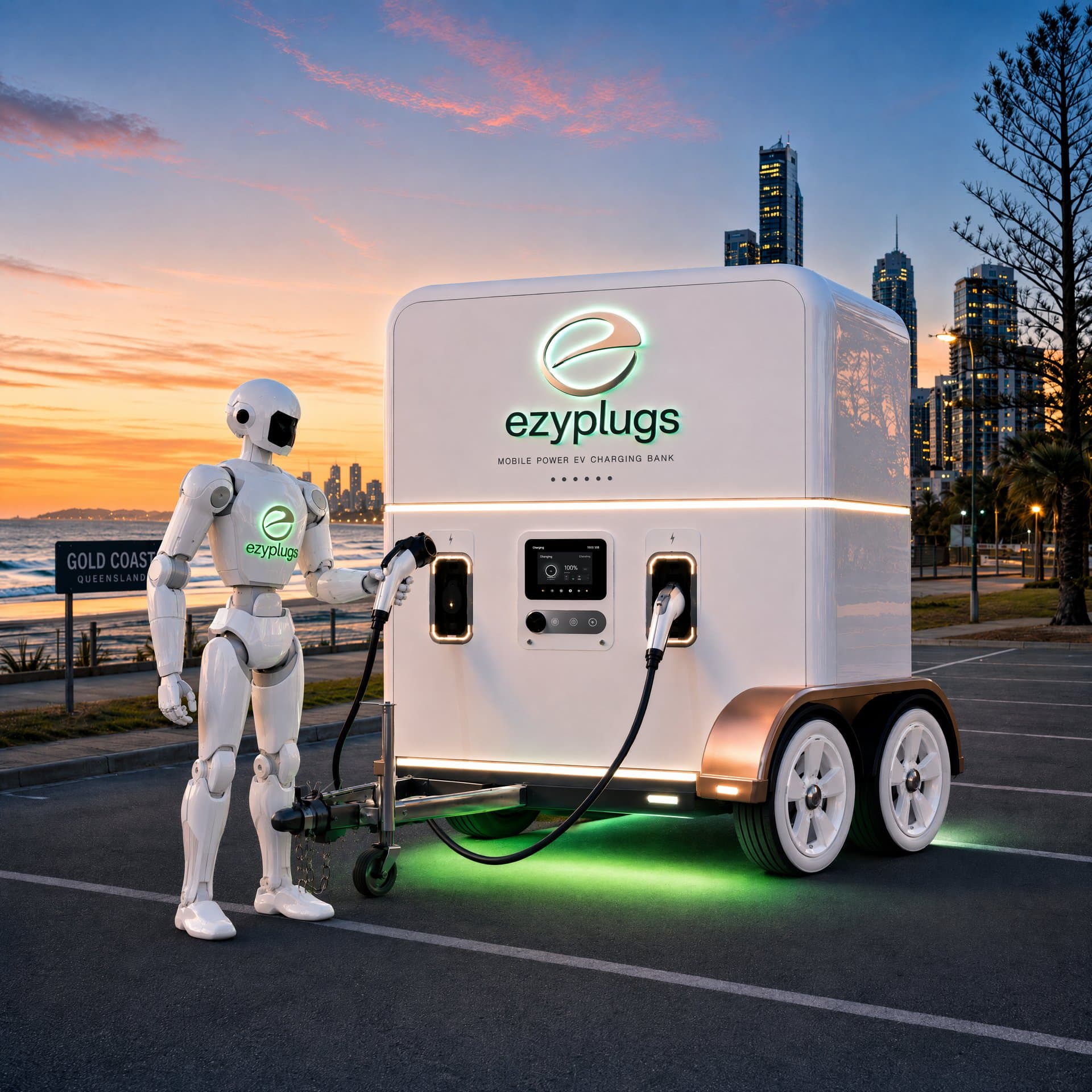
Optional marketing robot — a humanoid host that greets drivers and draws the crowd. Sold separately.
A Power Bank People Stop to Photograph.
Most advertising gets walked past. A glowing charging station in the middle of a festival gets queued for. Put your brand on the side, hand out the power, and be the name everyone’s phone thanks on the way home.
And when the event’s over, it goes home and keeps working — filling from your solar during the day at no extra cost.
What Could Your Solar Earn?
An indicative look at what the same rooftop solar is worth sent to the grid versus sold as phone and EV charging through your unit.
Most homes get 5–8 cents per kWh for solar sent to the grid. EV drivers pay 40–70 cents per kWh to charge. This calculator shows the difference.
- Exported to the grid
- $329 / yr
- Sold as EV charging
- $2,738 / yr
- Indicative difference
- +$2,409 / yr
Example: a 6.6 kW solar system sending 15 kWh a day to the grid.
Indicative only, not financial advice. Formula: daily export × 365 × (charging rate − feed-in tariff) ÷ 100. Actual results depend on how much charging you sell, your tariff and your costs.
Talk to Us
Units from $149,500 inc GST. Base unit: 120 kWh battery, two 22 kW EV plugs, road-legal trailer. Marketing robot and extra plugs are optional extras, priced separately. Questions, early orders, or want to talk through the numbers for your place or your events?
This robot is available — contact us to reserve your spot.
Join the Revolution.